Wednesday, 27 July 2011

On a grey summer morning

I had checked the tide tables and decided that this morning was the best to go and have an early walk by the Thames. So it proved. Nothing much by some other patches standards, but I was treated to 2 rare sights on mine:

The wader I tend to find the most, a Redshank at the edge of the water:
Redshank

A female Mallard with 4 ducklings:
ducklings
ducklings

Best luck to her, she looked pretty attentive, but the odds are against her. 2 years ago one managed to raise 9 to adulthood, so you never know...

Monday, 18 July 2011

Storks in Normandy

A month ago I went to visit my family back in Normandy and one afternoon, with my parents, we went to visit some of the White Stork nests that they know of in the Marais du Cotentin et du Bessin. Out of the 4 nests we checked, 3 had young in them but the fourth one, high up in a tree, had been partially destroyed.

We had some nice views of an adult looking for food in a field.

looking for food

looking for food

The first nest we saw, with 2 young in it, probably belonged to the adult above.

2 Stork young on nest

Second nest:

Adult and young Stork on nest

If you look closely at the young's leg, you'll notice it is wearing a colour ring.
If you look at the leaves, you'll also notice that it was really windy...

By the time, we got to the next nest, conditions were pretty dire and birds were barely visible. Quite an impressive nest though!

another nest

(click on any photo for a bigger version or to get you to the set which has a few more photos).
I chose and processed the photos while on the ferry back to the UK, but within a few days drama at the peregrines nest grabbed all my attention and I am now finally slowly catching up.
White storks are a bird I remember going to see in Alsace as a kid in 1976 during a family holiday, as the reintroduction programme was starting. It even was one of my younger brother's first words :) I never imagined then that they'd settle within an hour's drive of my parents.

Monday, 25 April 2011

Winter Thrushes are not only for Winter sometimes

What I had been hoping for back in February has happened :


Mistle Thrush are breeding in Margravine Cemetery!

I barely saw them in between, which is amazing considering how noisy and bold they can be, so I was thinking that they might have tried outside of the cemetery as I would see them quite often fly North, towards the Tube line.
Then about a week ago I heard their distinctive rattle a few times while walking through. Unfortunately I was so incapacitated at the time that walking on the rough ground looking for them was out of the question but I promised myself that as soon as I could I'd go looking for them. So Saturday morning Operation Mistle Thrush was put into gear and within 5 minutes, with a bit of luck, I located the nest with one of the birds on it. Happy time! Then yesterday I saw one of the birds bring food to 2 chicks.

Other birds not quite so far advanced in the breeding process are our local Peregrines, they started incubating 3 eggs about a week ago. I have started another blog to follow their progress: FaBPeregrines.

Wednesday, 6 April 2011

They're at it for another year


Yes, the Canada Geese have started nesting again on the wharf by the supermarket in Fulham Sands End.  However, this year they have changed their spot. Nest is made up of coiled rope, worn out bag and a bicycle saddle, and some down...  4th year of trying at least, maybe it'll be the right one... Best of luck!

Friday, 11 March 2011

Nice surprise!

During a break at the allotment this afternoon, I went to check the 'Nature area'. I was initially looking for Blackcaps, but this up in a tree was a very nice surprise instead:


I had been looking for some elsewhere in the park without luck so far, in relatively quieter parts, by the Thames, but this is so close to one of West London's busiest roads, Fulham Palace Road, it surprised me.
A pity the light was terrible and the angles difficult...

Thursday, 10 March 2011

A gull with a bone to pick

At the supermarket yesterday I was taking photos of a Common Gull hoping to read its metal ring (unfortunately it was presenting the closure part) when I noticed the Herring Gull YW3T from last week.


I then noticed a Common Gull had found itself a (chicken?) bone to nibble on but it turned out I wasn't the only one to have noticed:

Where is my bone?

A pair of Greylags followed by 3 others flying over the Thames were the surprise visitors at the supermarket yesterday, as well as a pair of Coots, which I rarely see there.
Numbers of Black-headed Gulls have continued to dwindle with only 70 of them on the wharf at high tide and I am looking forward to concentrate my attention to these little guys once they're gone:
They've started being very active and vocal again. One male was calling under the eaves of one of the apartment blocks, a new site for this year as far as I am aware.

Tuesday, 8 March 2011

2 for the price of 1

Like I do every week when I go to the supermarket, especially at high tide, I checked for rings on gulls' legs. In particular, I was hoping to see the semi-regular one, white A6LK, which I had last seen on 8th December. And bingo! at the end of the scan, when I thought all hope was gone, there it was:


I proceeded to take a few more photos, including this one. I am not entirely sure what is so attractive about this bush but a few gulls went and ate a few leaves off it.


Then on the panel with a few others (there was an exceptionally high number of them that day):


If you look closely at the one ready to land, you can glimpse an orange ring, and there it is, obvious once the bird had landed.


For once, the ring was very easy to read: YW3.T. I got the info back overnight: this Herring Gull was ringed at Pitsea Landfill site in November and mine was the first reading since. Map here.


Is that profile good for you?

I'm hoping that, like A6LK, it'll stick around and I can follow its progress from time to time.

Wednesday, 9 February 2011

Winter thrushes

Yes, I know, it's been a very long time since my last post. Not the best of months those past few ones... So I'm going to try and do a few catch-up posts.
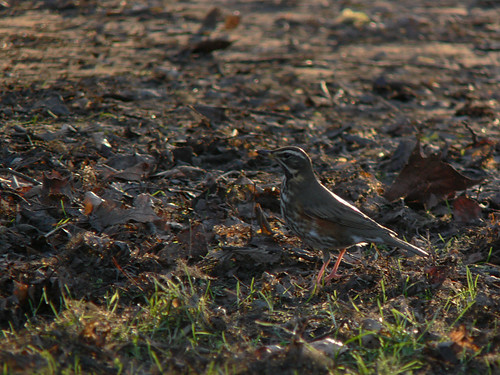
We've never had this winter the numbers of Redwings we had the previous one. I think the most I've seen at once were 30-35, twice, around the new year, whereas we had over 50 well into March last year. And since mid-January we've had about 3 knocking about, feeding on the ground since all the berries were gone a long time ago. Being so few, they are a lot trickier to find...

Not the best of photos, that bird was way too fast and this was the only passable one I managed, but I like how the light is making its legs look almost translucent 

The bonus this year has been a pair of Mistle Thrush since mid January. Mistle Thrushes usually only pass by, are harassed by the local Jays and Magpies, and move on. But, this time, one month on, they're still here, usually to be found together in the same area.  I have seen behaviour that looked like courtship once and another time it looked like they might be building a nest. So I'm crossing all I can, it would be a first...


I never thought of Redwings as being particularly small but this one really does next to a Mistle Thrush...

I am giving flickr a try for my photos, you can see a few more of these birds here.

Thursday, 16 September 2010

2 hours by the Thames

I went for a walk by the Thames between 10 & 12 this morning. I estimated this would be optimal for the tide, it was going down and started to reveal the foreshore which tends to be when the birds are at their most active. It wasn't however the ducks and waders feast I had been hoping for. None of the Starlings, Crows or Gulls materialised into something more important, but nevermind ;) I discovered that the part of Thames Path which had been closed earlier this year was finally reopened, and in time too! Brilliant, no more walking through the back streets and losing sight of the birds on the foreshore!
I saw:
  • Black-headed Gulls: about 150. Including the Finnish CC1H ringed one in almost the exact same spot (about 2m away)
  • Herring Gull: 4, including a pair in courtship display - I really thought they were starting to create a nest on the shore at some point. Weird at this time of year I would have thought...
  • Lesser Black-backed Gull: 1 family with 2 begging juveniles, and at least 2 more adults and 2 juveniles
  • Common Gull: 1
  • Mallard: 46
  • Tufted Duck: 10, including the female and 2 youngsters I have seen every time of late
  • Mute Swan: 1
  • Grey Heron: 1
  • Cormorant: 21, most of them on the wharf, but a few fishing (when not disturbed by passing boats)
  • Grey Wagtail: 1
  • Starlings: a flock of about 50 flitting between the shore and the bridge
  • Canada Goose: 4, including the usual Greylag hybrid
  • Ring-necked Parakeet: 6 on Hammersmith Bridge. I don't recall seeing them on the bridge before, it almost look like they were trying to dislodge some of the pigeons...
  • and the Egyptian Goose family :)
Initially, I only had one of the youngsters by the bridge, on its lonesome, going up and down, calling for the rest of the family.  Then, much later on, I had the rest of the family.

The ringed 'normal coloured' adult. I am still trying to get the first 2 digits, but either the angle is wrong, or there's mud on the ring... I'll get there one day, I hope.


The rest of the family, with the pale adult and the other 3 youngsters. 2 of them have pretty much reached adult size and feathering, but the 'little one' at the back is still playing catch-up.

A view from above.


You can see here how far behind it is compared to its sibling, still all fluffed up on its beck and back...
 There you can see pretty well the lump on its lower beak which has been visible since it is was a small gosling.  I am no expert, but my theory is that it's a thyroid problem.  If you have another idea, I'd welcome your thoughts.

Tuesday, 7 September 2010

White CC1H

A quick update on one of the colour ringed gulls from my previous post, white CC1H. It was ringed in Finland, as an adult, in 2000, making it at least 10 years old. Not much of a wonder the ring was in the state it was...

Sunday, 5 September 2010

My name is Nathalie and I'm addicted to reading bird rings

My apologies... Another post mostly about colour-ringed gulls...

I was doing my patch walk by the Thames yesterday as I often do on a Saturday morning and getting increasingly annoyed by 2 guys in kayaks. I'll give them the benefit of the doubt, but they kept on getting close to shore or alighting at the pier and pontoon. It was close to high tide and then birds have very little space to go to, which is good for me if I want to check for rings, but not that good as a lot of the birds just bugger off to the Wetland Centre. I had just got to Crabtree Wharf before them and had (thankfully) just finished counting the cormorants there (21) when one of the kayaks decided to hold onto the Wharf and all the cormorants and most of the gulls flew away. Nearly all the cormorants ended up going to the Wetland Centre, the gulls landed on the river but some came back. I locked onto a preening Black-headed Gull with a red ring. I didn't even need to check my notes this time to know I had already seen it as it has a pretty memorable code: A1 :)


I saw this gull in pretty much the same spot on 22 September 2009 and had a reply the same day form the ringer, Frank Majoor, that the bird had "been ringed as a first winter bird in November 2006 in Hilversum, a town in the Netherlands, some 30 km south-east of Amsterdam and 25 km north of Utrecht, according to Wikipedia". This makes it a 4 year old bird.

While I was taking photos, a 'friend' arrived saying "See, I've got a ring too!" and, yes, it had... Slightly broken, but still legible, and not one I had seen before: white CC1H. Checking the colour-ringing site told me afterwards that this bird should be from Finland. I have reported it, I'll blog the result if and when I get it.


Then I noticed that there was 1 Cormorant left and recognised it immediately. Unfortunately not because it had a ring but because it has some netting around its neck. I saw it a few times last year around October and November but had not seen it since and was beginning to wonder.


If you compare the photos with last year's you can see the netting is pretty much unchanged, that's sturdy stuff :(


Doesn't look too comfortable swallowing...

More photos of the gulls, as well as 2 oldish Tufted Ducklings, the first I have seen on the river, in my gallery.

Monday, 26 July 2010

How amazing is that?

The Black-headed have been back for a little while now, their numbers on the foreshore between Crabtree Wharf and Hammersmith Bridge are almost at winter level already. And there are a lot more juveniles this year than last. But what I'd really like is a Med(iterranean) Gull, so I keep on scanning. I mentioned it to Louis in Chiswick yesterday and he texted me that he had just seen one by the Eyot. By then, it was a bit too late for me to go and check, but, early this morning, instead of going to the allotment I went to search for a Med Gull.  No such luck. But, as I was scanning the gulls I noticed that one had a colour ring, so I grabbed my camera and tried a few shots.  At last, it got closer and presented the right profile: white UYC on right leg.

At home, I checked my records and realised I had seen this bird before, as I was off-patch, in Ladbroke Grove, last February.  There is a bridge over the canal, with a Sainsbury's on one side, it was on a building on the other side:


I did at the time report my sighting via the BTO website after I had no reply contacting the marker directly (as recommended). From what I gather, this bird has probably been rung in Denmark, but it's been almost 6 months now and I have not had any reply.  I shall try again with this second sighting, and we'll see how that goes...

Saturday, 10 July 2010

Mystery Duck

I know it's been a long time since my last post, I pretty much haven't had the time, and once you've let it go, it can be hard to get back.  One of the things that has kept me busy is my allotment, and it's coming back from there this morning via the Thames Patch that I spotted this duck among the Mallards by Crabtree Wharf.  My first impression was "Oh, one of those weird mallards..." but after closer inspection I am not convinced.  For a start, it's smaller, about 3/4 size of a Mallard as seen on the last photo when it decided to have a go at one. Then its eyes are red, more like a Pochard than a Mallard. But it has the shimmering green of a Mallard on its neck. A hybrid of some kind?  I let you judge for yourself, and if you have any idea, feel free to comment :)

Update 12 July: This is a Chestnut Teal. Another escapee. Thank you 'Anonymous'!


Quite cute, whatever it is, I think.

Wednesday, 26 May 2010

A6LK still there and a pigeon

This week, the Herring Gull with ring A6LK was at the supermarket again.  Here it is with a friend.


I am still learning about gulls, but, somehow, it looks like a female to me, some je-ne-sais-quoi... One thing for sure, next to the other one, some of its feathers are well worn out, but it appears moulting may have started as some others appear brand new.

There was another ringed bird on the wharf today. I don't know if it was lost and was just resting, it stuck like a sore thumb among the feral pigeons and was not really interacting with them. There is a white pigeon in that flock but, even at a distance, I could tell it was different. Closer, I could see it has a green ring on one of its legs, but I couldn't read it.


I have tried to find out what breed it is, without success, but I have to say this is a pretty little thing compared to a lot of those fancy pigeons I have just had to look at during my search...

Tuesday, 25 May 2010

Very low tide

Yesterday early morning, I stopped by the Thames at Crabtree Wharf on my way to the allotment and noticed that the tide was extremely, so the plan was to come back this morning, hoping for interesting birds attracted by the extra mud uncovered.

Well, the tide was definitely very low, and still going down. In fact it was even lower than when Thames21 organised the Low Tide Events earlier this year. But the birds were not really there.


Apart from a group of 10 Mute Swans (and there were a further 3 towards Hammersmith Bridge),  All 'wading' birds turned into pigeons or starlings


It exposed some structures I don't recall seeing before.

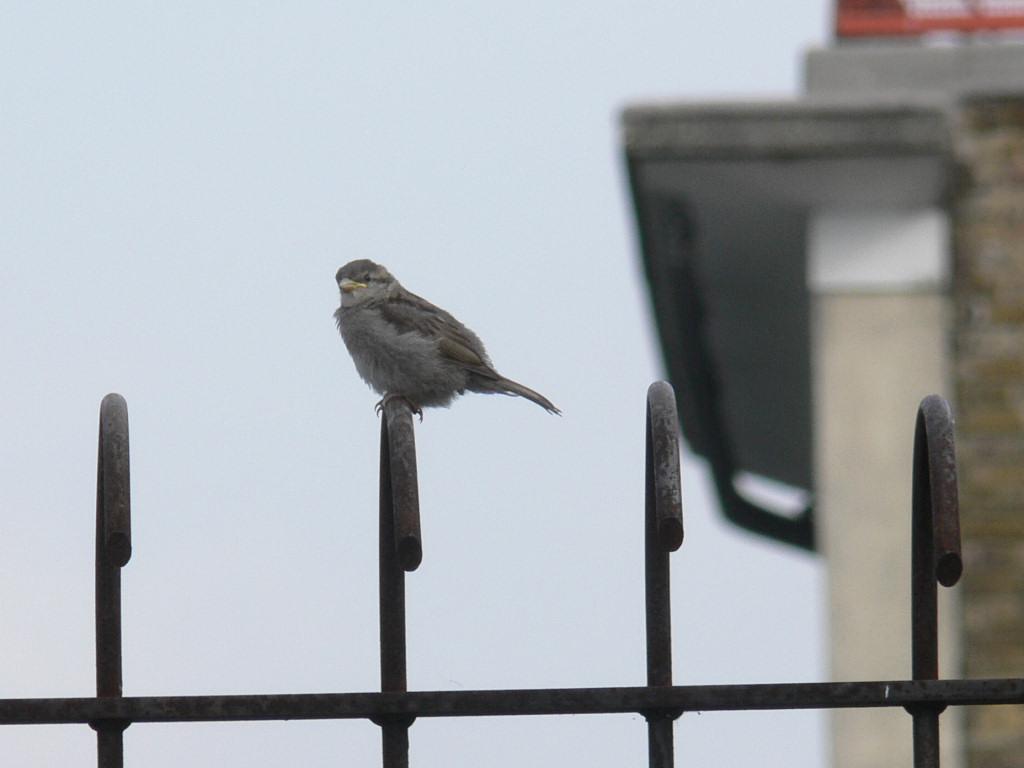
The best was when I got to the Riverside Studios: House Sparrow chicks!


They use the bushes/trees that grow on the wall lining the Thames.


House Sparrow doing cute